
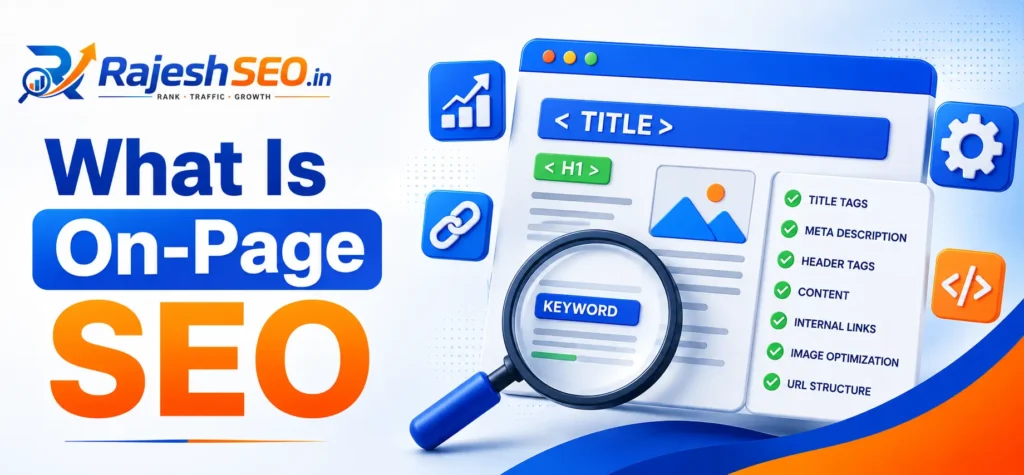
If you want your website to appear higher in Google search results, creating useful content is only part of the process. You also need to make sure that search engines can understand your pages and that users can easily find the information they need. This is where on-page SEO becomes important.
But what is on-page SEO, and how does it work?
On-page SEO is the process of optimizing individual web pages to improve their visibility in search engines and provide a better experience for visitors. It includes elements such as content, keywords, title tags, headings, URLs, internal links, images, and other page-level factors.
In this guide, Rajesh SEO explains the on-page SEO meaning, important on-page SEO techniques, key ranking factors, and a practical on-page SEO checklist for beginners.
What Is On-Page SEO?
On-page SEO is the practice of optimizing the content and HTML elements of a webpage so that search engines can better understand its topic and users can easily consume the information.
Another simple on-page SEO definition is:
On-page SEO is the process of improving the elements within a webpage to make it more relevant, useful, accessible, and understandable to both users and search engines.
It is also called on-page search engine optimization, on-site SEO, or website on-page SEO.
Unlike off-page SEO, which focuses mainly on activities outside your website, on-page SEO focuses on what you can optimize directly on your own webpages.
How Does On-Page SEO Work?
Search engines analyze many signals when understanding and ranking webpages. On-page optimization helps provide clear signals about the subject, purpose, and quality of a page.
For example, if you create a page about “local SEO services,” you can help search engines understand the page by using relevant terms naturally in the title, headings, content, URL, image alt text, and other appropriate areas.
However, effective on-page SEO is not about repeatedly adding the same keyword. Modern SEO focuses on relevance, usefulness, search intent, content quality, and a good user experience.
The basic process looks like this:
Search intent → Keyword research → Content creation → On-page optimization → Crawling and understanding → Search visibility
Why Is On-Page SEO Important?
The importance of on-page SEO comes from its ability to help search engines understand your webpage while making the content easier for visitors to use.
Some major benefits of on-page SEO include:
- Helps search engines understand your content.
- Improves the relevance of a page for target search queries.
- Creates a better website structure.
- Makes content easier to read and navigate.
- Helps search engines discover related pages through internal links.
- Improves image accessibility through descriptive alt text.
- Supports a better mobile experience.
- Helps strengthen topical relevance.
- Can improve organic search visibility when combined with other SEO efforts.
Good on-page SEO does not guarantee a first-page ranking. Search rankings also depend on factors such as competition, website authority, content quality, technical performance, and Google’s systems.
What Are the On-Page SEO Factors?
There are several important on-page SEO factors that should be considered when optimizing a webpage.
1. Keyword Optimization
Keyword optimization means using relevant search terms naturally in your content.
Start by understanding what your target audience is searching for. Then create content that satisfies that search intent.
Important places for relevant keywords can include:
- Page title
- Main heading
- Introduction
- Subheadings
- Main content
- URL
- Image alt text where appropriate
- Internal link anchor text
Avoid keyword stuffing. Your primary goal should be to create useful content for people rather than writing content only for search engines.
2. Title Tag Optimization
The title tag helps describe the topic of a webpage and can influence how the page is presented in search results.
For example:
Poor:
SEO | Rajesh SEO
Better:
What Is On-Page SEO? Complete Beginner’s Guide
A good title should accurately describe the page and naturally communicate its main topic.
3. Meta Description Optimization
A meta description provides a short summary of a webpage. While it is not generally treated as a direct Google ranking factor, a useful description can help users understand what they will find on the page.
For example:
What Is On-Page SEO? Learn the basics, key on-page SEO factors, techniques, benefits, and a beginner-friendly checklist to optimize your website for search engines.
Keep the description clear, relevant, and focused on the searcher’s needs.
4. Header Tag Optimization
Headings create a clear content structure.
Use one main H1 for the primary topic and organize supporting sections with H2 and H3 headings.
For example:
H1: What Is On-Page SEO?
H2: Why Is On-Page SEO Important?
H2: What Are the On-Page SEO Factors?
H3: Keyword Optimization
H3: Title Tag Optimization
This structure makes longer content easier to scan and understand.
5. URL Optimization
A clean URL helps users and search engines understand the page topic.
For example:
example.com/what-is-on-page-seo/
is clearer than:
example.com/page?id=4587
Use short, descriptive URLs and avoid unnecessary words or complicated parameters when possible.
6. Content Optimization
Content optimization is one of the most important parts of on-page SEO.
Create content that directly answers the user’s question and provides enough information to satisfy their search intent.
Good content should:
- Answer the main question early.
- Use clear headings.
- Provide useful examples.
- Cover relevant subtopics.
- Avoid unnecessary repetition.
- Be easy to read.
- Demonstrate appropriate expertise and experience.
- Be updated when information changes.
Instead of focusing only on keyword density, focus on whether the content completely answers the user’s needs.
7. Search Intent Optimization
Search intent refers to the reason behind a search query.
For example, someone searching “what is on-page SEO” is probably looking for an explanation or beginner’s guide.
Someone searching “on-page SEO services” may be looking for a service provider.
Understanding this difference helps you create the right type of page for the right audience.
This is why search intent optimization should be part of every on-page SEO strategy.
8. Internal Linking
Internal linking connects one page of your website to another page on the same website.
For example, an article about on-page SEO could link to related pages such as:
- What Is SEO?
- Technical SEO
- Local SEO
- SEO Services
- Keyword Research
Internal linking helps users discover related information and helps search engines understand relationships between pages.
Use descriptive and natural anchor text instead of repeatedly using exact-match keywords.
9. Image SEO and Alt Text Optimization
Images can improve content and make complex concepts easier to understand. However, they should also be optimized properly.
Basic image SEO includes:
- Using relevant image file names.
- Compressing large images.
- Choosing suitable formats.
- Providing descriptive alt text when appropriate.
- Avoiding unnecessarily large image dimensions.
Alt text optimization is mainly intended to describe an image for accessibility, especially for users who rely on screen readers. It should describe the image accurately rather than simply inserting keywords.
10. Mobile SEO Optimization
Most websites need to provide a strong experience across mobile devices.
Mobile SEO optimization includes making sure that:
- Text is easy to read.
- Buttons and links are easy to tap.
- Content fits the screen.
- Navigation works properly.
- Important information is accessible.
- Pages load efficiently.
A responsive website is an important part of providing a good overall user experience.
11. Page Speed and Core Web Vitals
Page performance can affect user experience. Slow pages may make it harder for visitors to access your content.
Page speed optimization can include:
- Compressing images.
- Reducing unnecessary scripts.
- Improving server performance.
- Using browser caching where appropriate.
- Removing unnecessary resources.
Google’s Core Web Vitals provide a set of user-experience metrics related to loading performance, responsiveness, and visual stability.
12. Schema Markup
Schema markup is structured data that helps search engines understand specific types of information on a webpage.
Depending on the content, structured data can describe things such as articles, products, organizations, events, and other supported entities.
Schema should accurately represent the content visible on the page and follow Google’s structured data guidelines.
On-Page SEO vs Off-Page SEO
A common beginner question is on-page SEO vs off-page SEO. The main difference is where the optimization happens.
| On-Page SEO | Off-Page SEO |
| Focuses on your website | Focuses on activities outside your website |
| Content optimization | Link building |
| Title and heading optimization | Digital PR |
| Internal linking | Brand mentions |
| URL optimization | External authority signals |
| Image SEO | Relationship and promotion activities |
Both approaches can work together as part of a broader SEO strategy.
How to Do On-Page SEO for a New Website?
If you are wondering how to do on-page SEO for a new website, start with the fundamentals.
Step 1: Understand Your Audience
Identify who your target audience is and what problems they want to solve.
Step 2: Perform Keyword Research
Find relevant keywords based on search intent, competition, and business relevance.
Step 3: Create Useful Content
Build pages that answer specific questions and provide genuine value.
Step 4: Optimize Page Elements
Improve titles, headings, URLs, meta descriptions, images, content, and internal links.
Step 5: Improve User Experience
Make your website mobile-friendly, easy to navigate, readable, and fast.
Step 6: Add Relevant Structured Data
Use schema markup when it is appropriate for your content.
Step 7: Monitor Performance
Use SEO tools and analytics platforms to monitor organic traffic, indexing, search queries, clicks, and other useful performance signals.
On-Page SEO Checklist for Beginners
Use this on-page SEO checklist when publishing a new webpage:
- Identify the primary search intent.
- Perform relevant keyword research.
- Create a clear and useful page title.
- Add a descriptive H1 heading.
- Organize content using H2 and H3 headings.
- Write a useful meta description.
- Create a clean and descriptive URL.
- Use keywords naturally.
- Optimize the content for search intent.
- Add relevant internal links.
- Optimize important images.
- Add descriptive alt text where appropriate.
- Check mobile usability.
- Improve page performance.
- Review Core Web Vitals.
- Add relevant schema markup.
- Check for broken links.
- Review the page before publishing.
Best On-Page SEO Practices
The best on-page SEO practices focus on users first while helping search engines understand your content.
Avoid creating pages simply to target a keyword. Instead, identify the user’s question, provide a complete answer, organize the information clearly, and support the content with relevant internal links and useful media.
You should also review existing pages regularly. Search behavior, competitors, business information, and industry trends can change over time.
How Does On-Page SEO Improve Website Ranking?
On-page SEO helps search engines understand what a page is about and how well it may satisfy a particular search intent.
For example, a well-optimized page clearly communicates its topic through its title, headings, content, URL, and related page elements. When the content is useful and relevant, it gives search engines stronger context for understanding the page.
However, how on-page SEO improves website ranking depends on the overall SEO picture. On-page optimization should work alongside technical SEO, content quality, internal linking, authority building, and other appropriate SEO activities.
Conclusion
So, what is on-page SEO?
On-page SEO is the process of optimizing individual webpages to make them more useful for visitors and easier for search engines to understand. It includes keyword optimization, content optimization, title tags, headings, URLs, internal linking, image SEO, mobile optimization, page performance, schema markup, and search intent optimization.
If you are new to SEO, start with the basics instead of trying to optimize everything at once. Understand the search intent, create useful content, structure the page clearly, optimize important page elements, and regularly review performance.
At Rajesh SEO, the focus is on creating practical SEO strategies that combine strong content, technical improvements, search intent, and user experience to build sustainable organic visibility.
If you are planning to improve your website’s organic search performance, a proper on-page SEO audit and optimization process can help identify opportunities and prioritize the changes that matter most.